Companion Star Solves Hot Dust Mystery
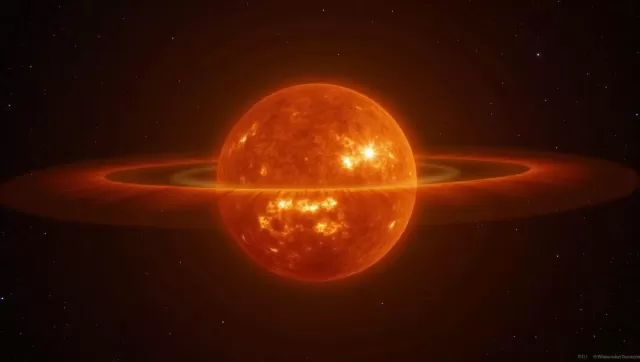
A major challenge in the search for planets like our own is the presence of a mysterious, glowing dust that can obscure our view. Now, a groundbreaking discovery around a star 70 light-years away is providing crucial clues to solving this cosmic puzzle. The star, Kappa Tucanae A, has long been a source of intrigue due to its surrounding shroud of dust, which is heated to extreme temperatures that defy conventional scientific understanding.
At the heart of this celestial enigma is a swirling cloud of superheated particles orbiting incredibly close to the star. According to the laws of physics, this dust should have been vaporized or blown away by intense stellar radiation long ago. The fact that it persists in such large quantities suggests a powerful, ongoing process is either replenishing it or protecting it from destruction. A research team at the University of Arizona's Steward Observatory now believes they have identified the culprit: a previously undetected companion star.
Publishing their work in The Astronomical Journal, scientists led by postdoctoral research associate Thomas Stuber detailed how they uncovered this hidden stellar partner. Using the sophisticated MATISSE instrument at the European Southern Observatory, they employed interferometry—a technique that combines light from multiple telescopes to create a single, more powerful virtual observatory. This method yielded the highest-contrast image of a companion star ever achieved with the technology, revealing an object moving in a highly unusual, elongated orbit.
This companion star's path is key to the mystery. It travels on a long, looping journey that periodically brings it plunging through the inner region of the system, right where the hot dust is located. At its closest point, the companion swings within 0.3 astronomical units of Kappa Tucanae A, a distance closer than Mercury's orbit around our sun. Researchers are confident that this repeated passage is directly linked to the dust's strange behavior. As co-author and Steward Observatory Associate Astronomer Steve Ertel noted, it's virtually impossible for the companion not to be dynamically interacting with the dust and influencing its production.
The discovery transforms the Kappa Tucanae A system from a simple puzzle into an invaluable natural laboratory. It provides a unique opportunity to study the extreme interactions that can sustain hot exozodiacal dust—a major obstacle for future planet-hunting missions. Telescopes like NASA's upcoming Habitable Worlds Observatory will rely on coronagraphs to block direct starlight, but this type of dust scatters light and creates a glare that can easily mask the faint signal of an Earth-like planet. Understanding the source and behavior of this dust is therefore essential for the success of these future endeavors.
This breakthrough builds on a long legacy of leadership in interferometry at the Steward Observatory. Its work on the Large Binocular Telescope Interferometer (LBTI) has been pivotal in studying exozodiacal dust and has established the institution as a world leader in the field. This expertise is now being leveraged to develop next-generation instruments, including a new European interferometer projected to be 50 times more sensitive.
With this new understanding of the Kappa Tucanae A system, scientists can now explore a host of new questions. They can investigate how the companion star's gravity influences the dust's composition, particle size, and distribution. The system also provides a testing ground for theories about whether magnetic fields could be trapping the dust or if it is constantly being refilled by a barrage of comets. The team now plans to revisit observations of other star systems with similar hot dust, suspecting that hidden companions may be a common feature. This unexpected finding has opened up exciting new pathways for resolving one of the most persistent challenges in the quest to find another Earth.