Ghost Particles Transform Carbon: A Universe Unveiled
In a significant breakthrough for particle physics, scientists have successfully observed solar neutrinos interacting with carbon atoms, adding a new element to the exclusive list of materials capable of detecting these elusive particles. Often called ghost particles, neutrinos stream from the Sun's core, passing through planets and people by the trillion every second with virtually no interaction, making them incredibly difficult to study.
Probing the Universe from Deep Underground
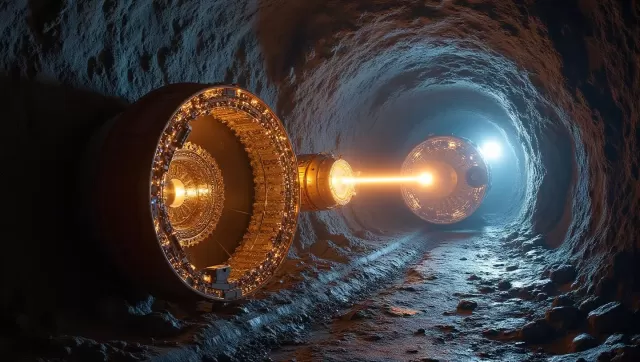
This groundbreaking observation was achieved by a team of researchers, spearheaded by the University of Oxford, using the SNO+ detector. This state-of-the-art instrument is situated two kilometers beneath the Earth's surface at SNOLAB in Sudbury, Canada. Operating within a functioning mine, the laboratory's immense depth provides essential shielding from cosmic rays and other background radiation, creating a pristine environment necessary for capturing the faint signals of neutrino interactions.
Capturing a Unique Double Flash of Light
The team's success hinged on identifying a very specific nuclear reaction: a high-energy neutrino colliding with a carbon-13 atom, transforming it into an unstable isotope, nitrogen-13. This radioactive nitrogen then decays approximately ten minutes later. To isolate these rare occurrences, the researchers employed a "delayed coincidence" method. They searched for a distinctive two-part light signal—the initial flash from the neutrino impact followed by a second flash from the nitrogen-13 decay minutes later. This paired signal provided undeniable evidence of a true neutrino event, allowing it to be clearly distinguished from ambient noise.
During an observation period lasting 231 days, from early May 2022 to late June 2023, the SNO+ detector registered 5.6 of these signature double flashes. This figure aligns remarkably well with theoretical models, which predicted 4.7 such events from solar neutrinos over the same timeframe, validating the team's findings.
A New Tool to Study the Cosmos
The peculiar behavior of neutrinos holds the key to understanding fundamental cosmic processes, from the mechanics of stellar fusion to the evolution of the universe itself. This new measurement provides scientists with an entirely new channel for investigating low-energy neutrino interactions. It effectively repurposes the constant stream of neutrinos from our Sun as a natural particle beam to probe other rare atomic phenomena. This achievement marks the first time this specific neutrino-carbon interaction has been directly measured, setting a new record for the lowest-energy observation of this process on carbon-13 nuclei.
Building on a Nobel Prize Legacy
The SNO+ experiment follows in the footsteps of its celebrated predecessor, the Sudbury Neutrino Observatory (SNO). The original SNO experiment fundamentally changed our understanding of particle physics by proving that neutrinos oscillate, or change between their three types—electron, muon, and tau—as they travel from the Sun. This discovery, which solved the long-standing solar neutrino problem, earned its leader, Arthur B. McDonald, a share of the 2015 Nobel Prize in Physics. The current discovery continues this legacy, leveraging the detector's components to push the frontiers of physics and open new avenues for exploring the universe's most enigmatic particles.