
Silver Treatment Boosts Solid-State Battery Durability
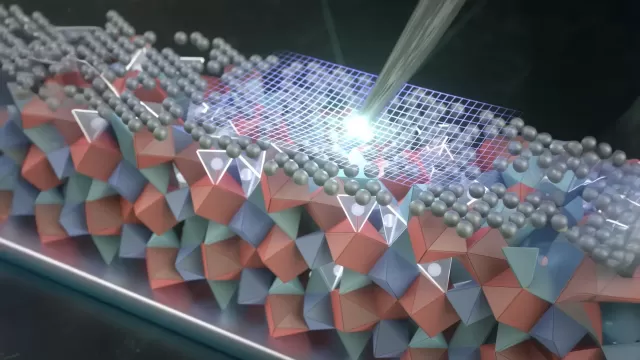
Solid-state lithium metal batteries represent the next frontier in energy storage, promising higher energy densities, faster charging speeds, and improved safety over traditional liquid-electrolyte batteries. However, the commercialization of this technology has long been stalled by the fragility of solid electrolytes. These ceramic-based materials are prone to microscopic fracturing, which leads to premature battery failure.
Why Solid Electrolytes Struggle with Durability
Solid electrolytes like LLZO—a combination of lithium, lanthanum, zirconium, and oxygen—behave much like household ceramics. While they facilitate the efficient movement of lithium ions, they are inherently brittle. During the repeated cycles of charging and discharging, tiny surface imperfections can expand into deep cracks.
This issue is particularly problematic during rapid charging. Under high-stress conditions, lithium can force its way into these microscopic flaws, creating conductive pathways that degrade the battery's internal structure. Because mass-producing defect-free ceramic sheets is both technically difficult and prohibitively expensive, researchers have turned their attention toward toughening the material's surface rather than perfecting its manufacturing.
Strengthening Ceramics with Ionic Silver
A research team at Stanford University has identified a sophisticated solution: a nanoscale surface treatment using silver. Unlike previous experiments that utilized metallic silver, this new approach focuses on silver ions (Ag+). By applying an ultra-thin 3-nanometer layer of silver and heating it to 300 degrees Celsius, the researchers triggered a chemical exchange.
During this process, the larger silver ions migrate into the electrolyte's surface, displacing smaller lithium atoms. This "doping" effect reaches approximately 50 nanometers deep and fundamentally alters the mechanical properties of the ceramic. The result is a surface that is five times more resistant to the pressure-induced cracking that typically ruins solid-state cells.
Key Advantages of the Silver Treatment
The implementation of this silver-ion layer offers several critical benefits for the future of battery design:
- Improved Crack Resistance: The treated surface can withstand significantly higher mechanical stress before fracturing.
- Lithium Intrusion Prevention: The presence of silver ions helps block lithium from entering existing surface flaws, a common cause of short-circuiting.
- Enhanced Fast-Charging Stability: By maintaining surface integrity, the battery can better handle the intense electrochemical pressures of rapid energy transfer.
- Manufacturing Feasibility: This coating provides a realistic way to protect electrolytes that may contain unavoidable manufacturing defects.
Expanding the Horizon of Energy Storage
While the current results are promising, the research team is now scaling the technology to test it within complete battery cells. They are also investigating how different types of mechanical pressure affect the lifespan of these treated electrolytes.
Beyond lithium-based systems, this discovery could have far-reaching implications for other battery chemistries. The researchers believe the technique could be applied to:
- Sodium-based batteries, which offer a more sustainable alternative to lithium.
- Sulfur-based solid electrolytes, known for their chemical compatibility with metal anodes.
- Other ionic treatments using metals like copper, though silver remains the most effective candidate found so far.
By focusing on the atomic-level reinforcement of the electrolyte surface, this breakthrough provides a clear pathway toward durable, high-performance solid-state batteries that can meet the demands of modern electric vehicles and consumer electronics.